Voices of Steve Carrell, Jason Segel, Russell Brand Directed by Pierre Coffin and Chris Renaud Family/ Comedy Rated PG
Synopsis:
Super Criminal Gru, seeks to become the greatest villain of all time by stealing the moon. He concocts a rather complex plan involving adopted three orphan girls in order to steal the necessary equipment from his nemesis, Vector, who has upstaged him at every turn. However, things go awry when Gru begins to bond with his new family.
Thoughts:
Gru has a lot of Steve Carrell’s usual mannerisms his performance. While he does try to disguise it with a Hollywood foreign accent, a lot of elements he is known for come to the surface. When he talked about getting older or having to lay off some of his walking cheese puff minions, I really felt like I was watching an episode of “The Office”. This wasn’t necessary a bad thing, it was just something I found a little distracting from the actual story. I can understand that with this being Illumination Animation’s first feature film, that they tried to capitalize on as much star power as they could afford.
On the other end of the casting spectrum we have Julie Andrews as Gru’s mother who makes only a few guttural noises in her limited amount of screen time. I just couldn’t help but think what a waste of potential that was. They managed to get Mary Poppins herself to be in their children’s movie, and did absolutely nothing with her. All the while I just couldn’t help but think of how ironic it would be if instead they had cast her as the intimidating mistress who runs the orphanage. I just think it would have been fun to cast against type like that.
One of the things that are hard to understand about this movie is the setting. Our two leads, Gru and Vector are supervillains who steal landmarks Carmen Sandiego style, and are both financed by an evil bank and are part of society of bad guys. There don’t seem to be any superheroes or secret agents to oppose these threats. The people we do see react don’t really seem to do anything. This is rather unfortunate as one of the movie’s funnier moments was at the beginning when we see the nations of the world going ludicrous precautions to safeguard their landmarks. I kind of wish there had been more scenes like this.
It is a bit hard to understand this setting when there really have any “rules” laid out. There’s a bit of contrived coincidence that the plot hinges on, were Gru builds a rocketship out of scrap parts to fly to the moon, so that he can steal it with his shrink ray. It just so happens that Gru can only launch his rocket on the same day as his new daughter’s dance recital. If you can build a rocket out of spare parts and use it to fly to the moon, and zap it with a shrink ray to hold it for ransom, then I’m sure you can launch on a day when you aren’t otherwise committed. The senile Dr. Nefario, has suddenly regained lucidity to exposit this bit, delivers this plot point. I don’t understand who this guy is that he can tell Gru what to do. Isn’t it Gru’s plan after all? Besides, the good doctor didn’t speak up that we know of during any of Gru’s other failings, so why now all of the sudden? There is no reason, other than because the plot depends upon it.
The animation is excellent. I am eager to see what comes out of Illumination Animation’s following films. The plot is contrived, and the situations with the kids fairly predictable. However, it is peppered with some good comedic moments but they are rather few and far between.
Starring Joey King, Selena Gomez
Directed by Elizabeth Allen
Family/Drama
Rated G
Based on the books by Beverly Cleary
Synopsis:
Ramona Quimby is an adventurous third grader who offer a unique perspective on the events around her and her family, such as her father losing his job, her Aunt Bee's budding love life and antics with her older sister Beezus.
Thoughts:
When I first heard about this movie I thought it would pitch the source material out the window and just try and be over the top cutesy. The proceeding trailer for “Marmaduke”, a movie which suffered such a fate, wasn’t exactly encouraging. Marketing is something that can really mess with your expectations. Selena Gomez’s size on the poster, fame from the Disney Channel and original song on the soundtrack made me think that she was the star and that the movie is about sibling rivalry. No, the title is truth in advertising as Joey King as Ramona is this film’s main attraction.
The first thing I noticed is that the movie isn’t an adaptation of any one book in the series but rather it just cherry picks bits of stories from each of the books. Which I suppose makes sense, after all the books were really just a string of vignettes strung together by a thin overarching plot and the movie does the same thing. Despite how many plot threads the movie has, the script does a very good job if introducing a lot of ideas and then quickly tying the knot so that the story isn’t too cumbersome.
The most glaring problem for me was that none of the 9-year old characters talk like they’re 9 years old. Ramona's independence seems more in line with a 13-year old than her actual age. It’s a bit hard to believe that Ramona can’t spell “delicious”, when she uses words like “individual” or “embellishment” on a regular basis. In something like “Peanuts” or “Calvin and Hobbes” the fact that children speak with such articulate vocabulary is because it is meant to be satires of adult behaviors, but in a world that tries to pass off as a real life their dialogue sounds unnatural and feels like a punch in the stomach every other time one of these kids opens their mouth.
Selena Gomez does a good job in role as Romana’s big sister Beezus, but her role in this movie really just feels like window dressing. In fact, I could say that for a lot of people. This movie has a lot of periphery characters each with their own subplots that we cut away from Ramona to follow every here and now. It can be a little distracting, but it helps to establish a world bigger than just our lead character and gives the events that much more dimension to their reality.
Because of the way the plot picks and chooses from various sources and introduces loads and loads of characters the story has a lot of peaks and valleys to it, but in the end, I think it balances out well. Even if you know the books well, there is genuine interest in wondering how it will work out in the end.
The movie has a tightly executed script and surprisingly good acting. While it can waffle at times between clichés and cuteness, it comes out all right by the end. If they could have tweaked the children’s dialogue it might gotten a higher score. Bottom line, it serves as a good example of family entertainment that doesn’t try stooping to the lowest common denominator.
Voices of Mandy Moore, Zachary Levi, Donna Murphy Directed by Nathan Greno and Byron Howard Family/Fantasy Rated PG
The road to “Tangled” has had just about as many twists and split ends as seventy feet of hair would. But for me, it is the end of a long, yet inevitable journey. The first time I heard about this movie was four years ago when I was studying for my degree in art history. While researching Eighteenth Century French Rococo paintings, I discovered an interview with Disney animator Glen Keane who was attracted to the lush romantic tone of this particular style of art and wanted to use computer animation to create the look of a moving painting.
I’ve always admired Disney Animation’s appreciation for art by referencing classic works in their movies. Whether it be Ariel admiring “Magdalene with the Smoking Flame” in “The Little Mermaid”, or homage to N.C. Wyeth’s paintings in “Treasure Planet”, or even the bizarre appearance of “American Gothic” in “Mulan”. So I made a mental note to follow the development of this feature, and it certainly took some interesting turns. After Glen Keane suffered heart conditions that forced him to distance himself from the project, it was handed off to quite a number of other people who all wanted to do something different from it. There was a phase in which is was called “Unbraided”, and tried to capitalize on the success of “Shrek”’s style of fractured fairy tales before changing hands again and again each bringing creative changes, which is usually the kiss of death for a movie. The process became a mess, but eventually, after nine years in production (three times the length of an animated feature takes to make) it was released in November as Disney’s 50th Animated Feature Film.
The story adapts the classic fairy tale of Rapunzel. The wicked Mother Gothel kidnaps and confines Princess Rapunzel to a hidden tower, using Rapunzel’s magic hair to stay eternally young. When a criminal on the run, Flynn Rider, stumbles across Rapunzel and her tower. She begs him to take her out to see the mystetious floating lights that appear in the night sky on her birthday each year. He reluctantly agrees and from there we have the “Romantic Road Trip” story, immortalized by the movie “It Happened One Night” but probably more familiar to younger audiences as the plot for “The Princess and The Frog”.
This movie has lot more snappy physical slapstick humor mixed with a number of quick reaction cuts and pokes fun at some of the trappings of a typical Disney film such as destiny and true love. This seems more in keeping with a Dreamworks or Warner Brothers film than a Disney animated feature, though there is still a classic Disney influence. The reveal of Rapunzel’s tower reminisenct of the reveal of the castle in “Beauty and the Beast”. Rapunzel also runs through a clearing in the forest, animals attracted to sound of her voice a la “Sleeping Beauty”. Then the camera swings over head before spinning around her during the course which has been done in too many Disney movies to get an accurate count. The musical numbers are also written by Alan Menken, who songs for “Aladdin”, “The Little Mermaid”, and “Beauty and the Beast”. The film's Academy-Awarded Nominated song "I See the Light", is very reminiscent of "Aladdin"'s "A Whole New World", with our two leads on a form of transportation (a boat, a la "Kiss the Girl" from "The Little Mermaid), admiring the beautiful scenery, falling in love while performing a duet.
The visuals are strong with hearty laughs and quality moments for good family entertainment. The formula may seem a bit familiar, but it is still interesting to watch. If they had pushed certain elements of the story I think it could have been a perfect 5. But after so much time and money were invested into this project, its likely the executives pushed it into a familiar direction. With that in mind, its probably a miracle we got something as good as we did.
Starring Georgie Henley, Skandar Keynes, Will Poulter, Simon Pegg Directed by Michael Apted Based on the book by C.S. Lewis Fantasy/ Family Rated PG
Introduction:
The Chronicles of Narnia were a very influential series in my childhood and I have enjoyed seeing these books adapted to the big screen. However, when I heard that Walden Media was having trouble coming up with the money for the third installment of the series, I knew that was the least of their problems. The Voyage of the Dawn Treader is probably the densest and most symbolism heavy book in the seven and doesn’t have so much a plot so much as it is a series of short stories threaded together by a common goal. I honestly thought that perhaps a five episode television miniseries would be better at conveying this particular story than a compact two-hour movie.
Disney jettisoned the Narnia series after “Prince Caspian” didn’t make the kind of money that the studio wanted. Twentieth Century Fox was quick to get there hands on the property, as they have been looking to create a lucrative fantasy franchise to par with “Harry Potter”, as seen with their failures in “Eragon”, “City of Ember”, and “Percy Jackson”. So Fox can claim to have both saved this series as well as having condemned it.
Summary:
The film begins with Edmund and Lucy having to stay with their unpleasant cousin Eustace, before the three children are suddenly plunged into Narnia once again. Given the dense material it only makes sense that we start off into things without any delay.
King Caspian exposits to the children that Narnia is at peace now, and that he is on a quest to find the missing seven lords who were briefly mentioned in the last film. I’m not sure why it’s necessary that the king himself go on this voyage, and makes him seem like a bit of micro manager. While Edmund and Lucy are all to happy to be back in Narnia, while Eustace is easily irritated by this strange new fantasy world. But the purpose of their quest soon switches gears as our heroes discover a green mist that swallows up innocent sailors. We are told it is a force of nature that is subtle and seeks to corrupt and influence those we go near it.
The establishment and exposition on this green meanie comes a little late into the game. Our heroes our told by on old wizard that to defeat the green mist, they must reunite seven swords on an island in the east. Everyone just responds, “Sure, why not?” So that it what they do.
Analysis:
For all the complaints I’m about to unleash, one the things I really did like about the movie was its lighthearted tone. Other recent fantasy movies like “Harry Potter” and “Twilight” have gotten gradually darker, whereas “Dawn Treader” keeps things fun and has some good humor to it. While the story may have been changed to suit the big screen, I’m grateful they didn’t follow the trend of making the series darker in an attempt to appeal to a wider audience.
One of the most obvious changes in this movie, (besides the plot) is Simon Pegg replacing Eddie Izzard as the voice of the warrior mouse, Reepicheep. His performance in this role easily steals the show. While the effects are impressive in this movie, it’s easy to see were most of the money went and I think it was pretty well spent.
Eustace’s naivety with his newfound surroundings is used primarily for comic relief. Thankfully he is used sparingly and effectively, as his incorrigible tendencies and cowardice could have easily made him intolerable if he were overused. During one of their many island encounters, a magic spell turns Eustace into a CG dragon. This results in a lot of his character development arc happening off camera, as the dragon isn’t as capable of showing emotions as his human actor, no matter how pig faced that actor might be. I imagine this change was a bigger part of the movie than it was in the book so that Dragon Eustace and Reepicheep could have more scenes together since both creatures were created by the computer, and the animators wouldn’t have to worry about mixing live action with animation when those two were together. During this time, Reepicheep gives Eustace the “You are meant for a great destiny” speech. It’s the kind you only get from movies and inept guidance counselors who don’t have any form of helpful advice. It is a trope that I hate so much.
There was no central antagonist in the original book, so the green mist was an invention for the film, and it makes sense that they would want to try and tie things together in a bit more familiar action movie-fight to the save the world plot. Also, after having the last two films with big bads that had to be beaten in a “Lord of the Rings” style battle charges, the idea of a subtle and intangible evil that seeks to tempt and influence our heroes seems like a cool idea. The only problem is there was nothing subtle about the green mist. Every time our heroes were tempted to do something wrong, the green mist would appear in the background just in case we were too dumb to figure out on ourselves.
Because the purpose of their voyage spends time switching gears there really isn’t a sense of anticipation, or anything that makes us excited about reaching the end goal. It really does feel as if our characters are making it up as they go along. Also since the book is so dense and the film is rather short, a lot of development and vices of the characters feel very compressed. It makes a lot of the various island adventures and magical creatures they encounter seem superficial.For example, after agreeing to defeat the green mist, Lucy gets herself a groupie, a little girl whose mother was taken by the mist. She has nothing to do with the plot, its just pathos, serving as a reminder that they are out here to actually do something. Edmund has a subplot about wanting power and Lucy has a subplot about wanting to be beautiful like her sister (which really could just be solved by applying “Whore Red” lipstick), but both subplots are resolved about as quickly as they are introduced.
The final conflict, is a bit weird. Not because it was scary, but because it was a touch inconsistent. After sailing into the dark island, we learn that the dark island has the power to manifest as the fears whatever you are thinking of. Edmund reacts by saying “Oh, no, I couldn’t help but think of it!” The others ask “What?” At least three people within earshot of me in the theater whispered to their neighbor “The Stay Puft Marshmallow Man!” Sadly, this is not the case. I thought that since the Green Mist appeared to Edmundtwice in this movie in the form of the White Witch from the first movie, and tempted him with power, saying that she “can make him a man”, that she might have manifest as a psychical evil to defeat for the final fight. But no, instead Edmund’s greatest fear is a sea serpent.
The ending feels a bit tacked on. After defeating the big evil, they spot an island on the horizon and decide to check it out. Edmund even says, “Might as well”, and I have to agree, they’ve come this far without any sort of plan or purpose, they might as well check that looks remotely interesting. In the book, reaching “the end of the world”, was one of the primary goals of their voyage, but now it’s nothing more than a rushed conclusion without any weight given to it. When given the choice of sailing to “the end of the world”, Caspian says he wants to go but cannot because he feels responsibility he left behind that we have never seen and have never been mentioned before this time. Aslan the lion shows up to remind us that he in fact still in the movie despite having made one other very brief appearance earlier. Also to remind that, just in case we forgot, he is supposed to be Jesus. There is some foreshadowing for the next movie in the series, but in all honestly I don’t think it’s going to happen. I am thankful that we got to the third movie, and that seems like a decent place to stop.
There is decent action, acting and effects, but no real anticipation or sense of build up. Instead we just have compressed character studies. There is a sense of risk, just not a whole lot. This is easily the weakest of the series, which is a shame is it is one of the stronger books of the series. It’s not boring at all, its just not very engaging either.
Final Score:
3 out of 5.Their heart is in the right place, just not in the pace.
Voices of Joseph Gordon-Levitt, Brian Murray, David Hyde Pierce, Emma Thompson, Martin Short Directed by Ron Clements and John Musker Adventure/ Science Fiction Rated PG: Action Peril Adapted from Treasure Island by Robert Louis Stevenson
Introduction:
The last time I spoke an animated film from Walt Disney Pictures, I spoke of “The Black Cauldron”, a horrible mess filled with wasted opportunities and that was best buried by the sands of time. In order to make up for that wreck of a film, I will now review another animated Disney that has largely gone unnoticed and deserves far more attention and better recognition.
What went wrong with this movie simply boils down to marketing. It was coming off the heels of the perplexingly popular "Star Wars Episode II: Attack of the Clones" and was released a mere week before the latest installments of two other juggernaut frachises; Lord of the Rings and Harry Potter. A film like this with such an eye-rolling premise didn’t stand a chance. The movie caved under the competition and the low income was deemed responsible for the eventually shutting down of Disney’s hand drawn animation studios. So when Disney was looking to revive the medium with “The Princess and the Frog”, they got these two directors again. Wait what? Well, actually it does make such given how Ron Clements and John Musker were responsible for the animation renaissance, making movies like “The Little Mermaid” and “Aladdin”, the later of which we shall see a substantial influence especially with the rebellious orphan male hero with his sidekicks, flying around an exploding cave of gold on his flying board.
Summary:
The film shares the same writers as the “Pirates of the Caribbean” movies and continues the blend of maritime action and humor, particular when it comes to the characters. Jim Hawkins (Joseph Gordon-Levitt, once again playing a teenager from outer space) is portrayed as moody teen with a lot of potential but no direction. He is taken under the wing of a rough old cyborg sailor named John Silver (Brian Murray), who teaches him the ropes, even giving him “The Destiny Speech”. (Unlike “Astro Boy”, the word “destiny” is never used in the speech, and is used to effectively guide Jim out of his funk and spark a change in his character for the better. Also the corniness of the trope is referenced by another character.) Doctor Delbert Doppler (David Hyde Pierce), is our primary comic relief, frequently stumbleing over his tongue, especially in the presence of the beautiful, yet stern Captain Amelia (Emma Thompson). The two remaining characters of note are the two “Disney sidekick” characters intended to become breakout stars and help sell toys; the shape shifting Morph, and the bipolar robot B.E.N. (Martin Short) These two are feel reminiscent of the various sidekicks from “Aladdin”. Morph’s faux-English and ability to fall into trouble is much like that of Abu, while B.E.N. spontaneous outbursts feel like leftovers from The Genie, and may have been less irritating had they come from the mouth of Robin Williams. Together, they’re off in search of riches and adventure IN SPACE!!!!
Analysis:
The surrogate father-son relationship between Jim and Silver is at the forefront of the film and is easily its strongest part, and reminds me of why this makes for a better adaptation than say “Muppet Treasure Island”, where there is a similar mix of the classic story with various anachronisms and several strange creatures. In that film, the relationship between Jim and Silver was mismatched by the child actors low key performance and Tim Curry as Silver being his usual over-the-top self, so that they only thing left to focus on is the weirdos in the background. Here the weirdos in the background serve as flavoring for the story and help establish the world they inhabit.
The setting of “Treasure Planet” is a rather unique one. The film employs and mixture of both traditional hand drawn animation and three dimensional computer animation. Anything made of skin or having an organic feel is done traditionally, while anything mechanical is rendered by computer animation. This creates an incredibly interesting effect on John Silver, who is half man and half machine. The environment of the film seems to have taken this same approach, mixing the book’s original setting during the Second Industrial Revolution with more contemporary science fiction, effectively combining Steam Punk with Cyber Punk creating what I shall dub as “Solar Punk”. The look of the film borrows heavily from the style of artist, N.C. Wyeth who illustrated the original “Treasure Island”. As an illustrator myself, this is going to gain it some extra points in my book. This also makes for serving some engaging sight gags to further one of the film’s themes that “Not everything is what it seems”, such as moments we see what appear to be quaint wooden building, only to get closer and see that they are made out of rivets and gears. Despite being close to a decade old, the computer animatied portions still hold up well, and being a Disney film, the traditional animation is second to none
Action Packed, Astoundingly Animated, Humorous, and ultimately moving (Kudos to the music by James Newton Howard) This one is a winner.
Voices of James Van Der Beek, Anna Paquin, Mark Hamill, Cloris Leachman
Directed by Hayao Miyazaki
Fantasy/ Adventure
Rated PG: Perilous Situations
The film opens with sky pirates attacking an airship, attempting to capture a girl named Sheeta (Anna Paquin) and her pendant, but she accidentally falls out of the ship, fortunately her pendant starts glowly and floats her to safety. This is a rather confusing opening actually as we don't learn who Sheeta is, why she was on the airship, what the pendant is or why the pirates were after it until much later. I imagine this is supposed to generate suspense, but it's rather confusing as I have no idea who this girl is or why I should care about her, even if she is working some kind of mystic mojo with her magic necklace.
We're given proper introductions when Sheeta is caught in her float from above by a miner boy named Pazu (James Van Der Beek), who provides us with his own back story about continuing his father's quest for Laputa, the castle in the sky. There isn't much time to dwell on this exposition though, as the pirates come back to settle the score leading to one of the most exciting chase scenes I think I've seen in any movie. This culminates with our two heroes being captured by the army, revealing that they are also looking for Laputa and its great power, aided in their quest by the sinister Muska (Mark Hamill) We also learn that Sheeta is an heir to the throne of Laputa and her pendant can lead them it.
With the help of the pirates, Pazu is able to free Sheeta and they race to reach Laputa first. We spend most of our time from here on out with these sky scoundrels who as it turns out have hearts of gold and serve as effective comic relief with their larger than life personalities, particularly that of their boisterous leader, Dola (Cloris Leachman)
Eventually they find the castle in the sky and both the characters and the audience are stunned by it's serene beauty. While the visuals have been impressive, the animation in the third act is simply mesmerizing. There is a dramatic confrontation in the end, were Muska arrives and reveals himself as another heir to the throne, and plans the seize power for himself, betraying his soldiers and casting them to their deaths. A cold move, but it shows just how effective a villain Mark Hamill can play. Fortunately our heroes manage to save the day using a plot device that we introduced shortly before they arrived here, so it feels like a little bit of cheat resolution, but is made up for by one last scene reuniting with the pirates before literally flying away.
Unlike some of Miyazaki's other films that I saw prior to this one such as "Kiki's Delivery Service" or "Porco Rosso", this one actually has something of a plot . To to his credit though, Miyazaki does often find a way to make these films work even without a plot, miraculously enough. Like all of his movies, the characters are very enduring and likable, easily outshining the situations they are placed into. The backstory of both Laputa and our antagonist is rather rough, and I am still a bit in the dark about Sheeta and Muska's connection to the castle. How are they both heirs to Laputa when we see that the place is abandoned? The animation is top notch and the score is nothing to ignore. A few plot holes aside it is still a genuinely entertaining film.
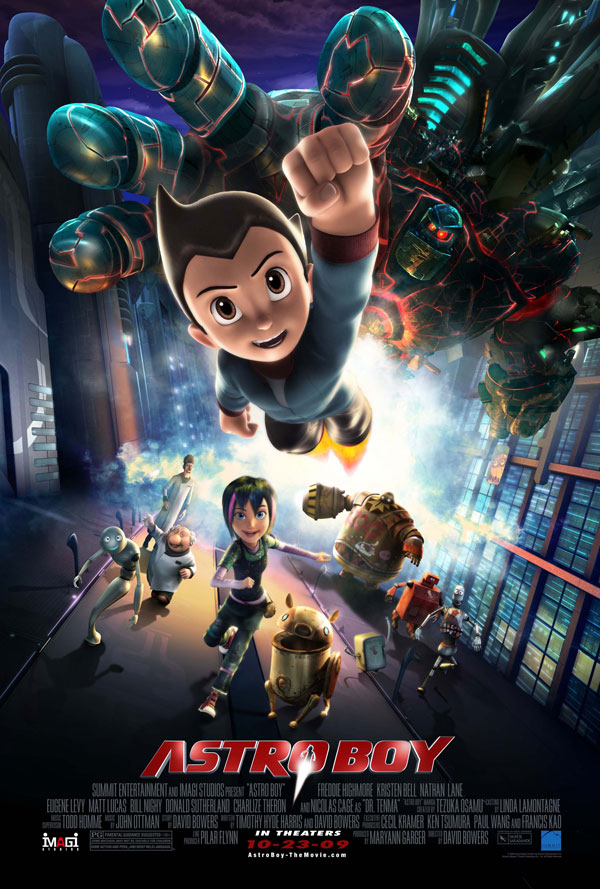
The film opens with some weird tunnel effect were we see all the names of actors roped into doing voices for this movie, many of whom are just here for the sake of having their names recognized by the adults in the audience, as recognizing them in the movie isn't always easy, with the exception of Nicholas Cage whose voice is the most discernible, and yet is the only one saddled with his character's name in the titles.
From there we see the futuristic flying land mass of Metro City and our protagonist Toby (Freddie Highmore) and his distant father, the robotics genius Dr. Tenma, who is voiced by Nicolas Cage, in what I believe to be the most subdued performance of his career. Maybe its because he isn't used to doing voice acting, but it really sounds like he just read the lines and then left the recording studio. I guess this is how you would describe, “phoning it in.”
Toby sneaks into a labrotory to watch a demonstration a robot his father is working on for the military, but is killed during a test by the robot's live ammo. Apparently weapons testing in movies are never done with rubber bullets or fail safes. Its also curious how Toby actually is vaporized by the robot and I’m left wondering; “Wait, where’d he go?” We just get his hat on the ground and Dr. Tenma saying “He’s gone”, because I guess you can't say "dead" is a children's movie (which is strange given how they say “kill” twice by the end). If it were up to me, I’d put his limp arm in a pile of debris, so we can at least have some sort of visual cue to help us “make the connection” that I’ve mentioned previously in my reviews of “The Fly” and “The Wolf Man”, which essentially boils down to “Show, Don’t Tell”.
During this test we’re introduced to our antagonist President Stone (Donald Sutherland), He is a dim-witted warmonger obsessed with re-election, building bigger and deadlier weapons for a non-existent arms race with a campaign slogan, “We don’t need change.” Subtle. I can understand what they’re going for with a pastiche of George W. Bush traits, but it just feels a bit tasteless. Fortunately Donald Sutherland plays him sinister rather than campy, which would have wrecked any threat he posed entirely.
Now we get to the most interesting part which as Dr. Tenma builds a robot duplicate of Toby powered by "The Blue Core", which runs on positive energy and programs in all of Toby's memories but is disappointed that the robot isn’t exactly like his dead son and Toby slowly discovers the truth about what he is. There is a great scene where he discovers of his jet boots and a fast flight sequence with some great visual gags along the way. Tenma can’t bring himself to accept this replacement and shoes Toby away. I feel like some anger may have been appropriate here, but Nick Cage can barely raise his voice throughout the entire film. His friend, Dr. Elefun (Bill Nighy) gives a speech about “finding your destiny”, which has lead me to the conclusion that “destiny” is the most overused word in cinema.
Toby is soon confronted with Stone’s infantry, who want the Blue Core for their military robots, which it involves some cool action scenes, it also has more than a fair share of head scratching moments such as the faceless infantry having computer readouts on their helmets that reveal their their emotions and bowel movements (?), or when Toby saves the life of a falling soldier who, after being rescued jumps off a building (?) or when President Stone orders a giant intimidating ship to shoot Toby down, the ship is hidden by the framing for the shot so that we can’t see it’s full size and appreciate how threatening it is.
Anyway Toby is shot down off the flying island and into the trash heaps on the surface like something out of "WALL-E". He meets with up with a group of other kids lead by the punky pseudo love interest Cora, (Kristen Bell) and their surrogate father Hamegg (Nathan Lane), who is essentially just an animated version of Nathan Lane himself. The film really starts to dip here as the humor also starts to become more and more juvenile. Toby bonds with the kids, but keeps the fact that he’s a robot a secret because he wants them to “warm up to him”, because continuing to lie to them will endure them to you.
The writing gets really sloppy here as we are introduced to Isaac Asimov's famed Three Laws of Robotics, of which we only learn one, the others are just skimmed over, which is odd given how it’s mentioned quite at least three times after this. It seems that everyone in the audience is expected to know what they are without being explained, and I don't know how many kids are familiar with the concept. It's also frustrating how these laws are mentioned so many times but serve little to no function in the plot, so why bother even bringing it up? Toby also acquires the name “Astro”, because… because we need to tie it back into the name of the source material somehow. Eventually, Hamegg reveals to the others that Toby is a robot and forces him to fight in the robot gladiator games, only to be saved by a robot Toby revived with his Blue Core earlier named Zog (Samuel L Jackson). Being powered by the Blue Core, which represents all that is good and positive, Zog attempts to kill Hamegg in cold blood and would have succeeded had it not been for Toby intervening. What's up with that?
Anyway, we reach the climax as Toby is captured by Stone, Tenma reveals that he loves him, theres more talk of “destiny” and Toby has a fight with Stone's giant robot. The surface kids also tell Toby they love him and together we we all learn a lesson about accepting people the way they are right before Toby flys off to launch an unprovoked attack with a giant squid that fell from space. Wait What?!
I'm not too familiar with Japanese Manga that serves as the source material so I will judge it based solely on it's own merits. While the first third of the film shows some promise with an interesting premise and a few funny gags, the following acts slowly decline. The animation as a whole is alright, but there's nothing really wow-inducing. While there are some great action set pieces throughout, its not enough to cover up the plot holes.
Starring Fairuza Balk, Nichol Williamson, Jean Marsh Directed by Walter Murch Fantasy Rated PG: Some Frightening Images Based on The Marvelous Land of Oz and Ozma of Oz by L. Frank Baum
The film opens to Dorothy Gale (Fairuza Balk) lying awake in bed staring up at the stars. We learn from Auntie Em and Uncle Henry's late night exposition that Dorothy hasn’t been able to sleep since the tornado from “The Wizard of Oz” and can’t stop talking about Oz, which no one believes really exists. They are also considering taking Dorothy to a clinic to receive electroshock therapy. What puzzles me is why Dorothy would be unable to sleep after triumphing over evil in another world, making such strong friendships and returning home safely. I would think she’d sleep more peacefully than ever after such a happy ending, but such is not the case. We also learn that the house hasn’t been rebuilt since the tornado, the harvest has been poor, money is tight, the chickens aren’t laying eggs and Uncle Henry has hurt his leg and can’t work. Dorothy and Aunt Em’s ride to the clinic only emphasizes the gloominess of the whole situation, as they travel through a vast, empty landscape capped by an imposing gray sky. Everything in the movie thus far has been filled with dread and apprehension, and it doesn’t get much better.
Arriving at the clinic, Dorothy talks to Doctor Worley (Nichol Williamson) about her trip to Oz with such astonishing detail you really have to wonder why no one has considered that she might have actually been there. Anyway, the doctor prescribes his shock therapy and turns Dorothy over to Nurse Wilson (Jean Marsh), who wears a long black dress with spiked shoulders and more buckles than Edward Scissorhands’s suit, just in case you didn’t realize you were supposed to be intimidated. Also during this time, we are shown things for the express purpose of seeing them as characters in Oz, such as when Dorothy receives a Jack-o-Lantern because “Its almost Halloween.” It would have been subtler if they said “This will become an anthropomorphic character later.”
Anyway, Dorthoy escapes with the help of a mysterious blonde girl, but gets washed away by a rushing river and finds herself back in Oz. However, this is not the Oz she remembers as Munchkinland is destroyed (even thought Dorothy’s house is still standing), the yellow brick road has fallen apart and the Emarald City has collapsed, and its citizens turned into stone by The Nome King (Nichol Williamson) and the evil witch Mombi (Jean Marsh) While evading Mombi’s soldiers, the cackling Wheelers, Dorothy gains some new friends to help her; the robot “Tick Tock”, the Scarecrow-esque Jack Pumpkinhead and the talking chicken Belinda. Eventually they are captured by Mombi and locked in a tower, but manage to make an easy escape thanks to a moose-headed flying sofa called “The Gump”. No, really.
They arrive at the land of the Nome King and plead for the city’s emeralds and the return of The Scarecrow (as he was the king of Oz apparently). The Nome King refuses to give them up and gives them a challenge. Presenting them with a room full of ornaments and the challenge to guess which one he turned the Scarecrow into. Eventually Dorothy guesses correctly, which enrages the Nome King as he turns into a giant stop motion monster threatening to devour them all, but is defeated by Belinda laying an egg in his mouth. No, really. All is restored and Dorothy learns that the blonde girl who helped her is in fact the rightful ruler of Oz, Ozma. Dorothy returns back to Kansas and for a more or less happy ending.
Everything about this movie is dull and dreary, even when we get to Oz there is no joy at all. There are no colorful landscapes, no charming characters and enjoyable elements of escapism to endure us to Oz or to their quest. Even in the end when all order is restored, there is a monotone reaction by everyone. Dorothy’s friends from the original “Wizard”; Scarecrow, Tin Man and Cowardly Lion, appear in a cameo when all is made right, but they don’t do or say anything, and serve only to remind us of how much more enjoyable the original was to us. The scale of the barren Kansas we see at the beginning is more spacious than the sets we see in Oz which seems limited to castles or caves and lacks the scale of how big Oz really is and resulting in a discomforting claustrophoic feeling. While there is some spectacular stop motion animation for the Nome King and his rock people as well as some good animatronics for Dorothy’s new friends, it just feels like the film is exploiting the talents of these artists and craftsman to do all the heavy lifting for a movie that doesn’t hold out any hope. It reminds me of what Tick Tock said at the beginning of the film; “I have always valued my lifelessness.” That sentence seems to sum it all up.
Voices of Grant Bardsley, Susan Sheridan, John Hurt, John Byner Directed by Ted Berman and Richard Rich Fantasy Rated PG: Some Frightening Images Based on The Chronicles of Prydain by Lloyd Alexander
The film opens and introduces us to a farm boy named Taran who fantasizing about being a great warrior despite being a pretty lousy at his current job as an assistant pig-keeper for his master Dallben. In fact, most of the Taran's troubles stem from his daydreaming which prevents him from focusing on this appointed task. I wonder if this kid has ever heard that phrase, “He who is faithful with the small things will be faithful in the big things”. I can understand him wanting to rise above his lowly position, but its hard to have sympathy when he keeps screwing up something so simple. However, he does get the call to adventure when he learns that the evil Horned King (John Hurt) has returned and he wants Taran's pig Hen Wen, who can see into the future. After escaping to farm to get Hen Wen to safety, he quickly loses her. Way to go idiot. At least he is humbled by this experiences, which alone makes him more enduring than that whiny brat from "Eragon" (which sounds a lot like “Arrogant” now that I think about it) Taran goes off to rescue her, and encounters a few people along the way. The first is the furry Gurgi (John Byner), we looks very much like a very hairy dog, and is likely meant to be cutesy marketable or comic relief in the typical “Disney sidekick” fashion. Thankfully his role is small and he doesn’t reach anywhere near Jar Jar Binks level of annoyance, but he gets very close. His cowardice doesn't make him very enticing to the audience either. Taran tracks Hen Wen down to a miniature version of Mordor which is apparently within walking distance and gets bullied about by some guards at a castle and is thrown into prison.
Taran is eventually recused from his captivity by Princess Eilonwy (Susan Sheridan), who is also there in this castle and can make her way about freely for reasons that are never explained. This is the part of the movie where I realize that it is best not to ask questions, because her appearance got me to thinking about a few things. First, if she’s a princess, does that mean that there are other royals?, a kingdom with an army of mounted men perhaps? Does this land they’re in even have a name? It also doesn't help matters that she is constantly referred to as "Princess", making it easy to forget her mouthful of a name. That's another thing, Eilonwy doesn't do anything "Princess-y". I suspect its just there because this is a fantasy movie, and fantasy movies have princesses, because if she were just an average girl who actually did something, there is no way people would accept it, right? The two also free a middle-aged minstrel named Fflam from the prison and he escapes with the two, but other than that, he serves no real purpose. In the original books (which I can just scarcely remember reading at a young age) Fflam's gimmick was that his harp's strings break whenever he lies. While his harp and breaking strings are present, they are never explained, and his harp disappears halfway through the film anyway.
In the end we see the Horned King uses titular black cauldron to resurrect at least six of the skeleton soldiers from "Jason and the Argonauts". Hardly what I'd call a formidable force, even if they are “indestructible” as we are told. Our heroes bargain for the chance to destroy the cauldron by exchanging the magic sword they found on their travels with a trio of witches. Yeah, because you want to give such a powerful artifact over to witches. Not to mention that it seems to me that you could probably destroy the magic cauldron with a magic sword. But then again, all the seems to make to sword magical, is that it sparkles when it cuts through things. But it turns out that the cauldron can only be destroyed by someone willingly going into it and never returning. Gurgi chooses to go but since he wasn’t a very distinct or likeable character in the first place there is no sense of loss, and when the Horned King's army is defeat, the witches bring Gurgi back to life anyway, which is a serious dramatic contradiction. The only thing that could have been worse is if someone had divided by zero. Also, Taran and Eilonwy kiss and the forest animals blush. I guess they are made for each in that they are both have no real personality. Oh, and Hen Wen the pig went back home to Dallben, and has apparently been there all this time. I'm sure you were all concerned.
While the animation quality is excellent, that comes standard with the Walt Disney Company, by the end there is nothing that is really visually distinct here for you to remember. Characters are introduced with nothing to make them unique, useful or interesting. Arguably Fflam could have been cut out with no great effect, it certainly would have given Taran and Eilonwy more time to connect and develop as characters, with Gurgi acting as moderator perhaps. Ultimately, its most damning flaw is that there is no sense of scale or risk. It is honestly like watching “Lord of the Rings” set in a suburban backyard. We are told there is great danger if the Horned King is able to raise his armies from the Black Cauldron, but we are never really told what the consequences will be if this happens, or what is at stake if our heroes do not succeed in destroying the black cauldron. If there is nothing at risk, then why should the audience care?