Monday, February 21, 2011
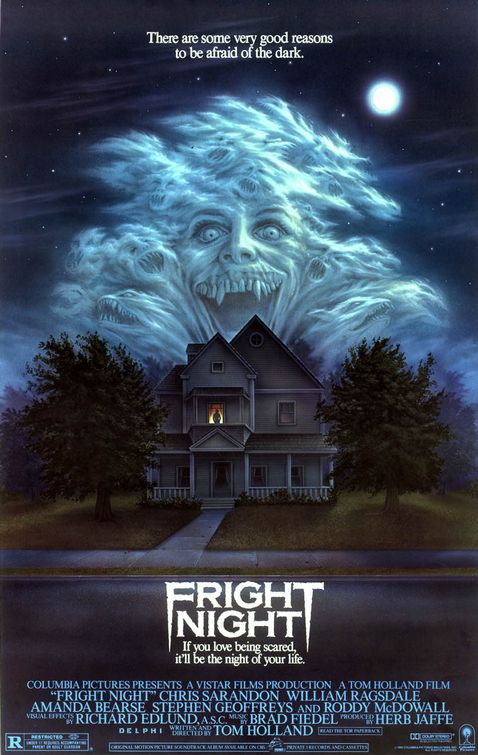
Fright Night (1985)
Friday, January 28, 2011
Matinee (1993)
Friday, January 7, 2011
The Blob (1988)

Starring Kevin Dillon, Shawnee Smith
Directed by Chuck Russell
Horror
Rated R
The movie opens with a decent from space to shots of a small, empty town in Anywhere, USA. There is foreboding music in the background to help establish the dark tone.
Aside of a few details, the story is the same as the original 1958 “The Blob”, with a Blob monster falling from outer space, consuming unsuspecting victims and its up to two teenagers to try and stop it from destroying the town.
The best thing about this film is how efficiently it uses the first act to establish its characters. Each person has a little bit of dimension and development so that they all seem important to a certain degree and results in all the more surprise and shock when a character becomes a victim of the Blob. It really helps the audience to care about trying to stop the situation and really invests us in the story more so than your average monster run amok type of movie.
Instead of just being regular teenagers, our lead characters are Brian is a juvenile delinquent with authority issues and Meg, a goody-good cheerleader from a wealthy family. They have decent chemistry but nowhere near as much charisma as Steve McQueen and company in the original.
The Blob effects in this version are decent. It should really go without saying that this is a bloodier and gorier Blob, so we get to see it tear apart and digest its victims, getting redder as it eats more, colored by the blood. While this Blob has more onscreen kills than the original, the actual deaths we do see are so brief that the shock sticks to our subconscious and comes across as more terrifying in our minds.
The problem is that the menace of the Blob is undermined by the introduction of a human antagonist, the corrupt government scientist Dr. Meaddows. While it first he comes across as an eleventh hour savior to stop the monster, his wooden and exposition heavy dialogue really give him away. He brings the story to a halt as he explains that the Blob is a biological weapon that he has designed and how he’d rather let the entire town be destroyed that have his experiment be lost. He’s just relishes in what a two dimensional bad guy he is and it really upstages the motiveless Blob. He death by the creature he created is far more satisfactory to the viewer than the destruction of the Blob in the end.
Speaking of which, the climax occurs when a “Jaws”-style tank explosion. Meg suddenly starts acting like Sigourney Weaver from “Aliens” and spewing typical monster killing dialogue firing multiple shots from an assault rifle trying to hit the Liquid Nitrogen tank that will freeze the Blob.
That would be the end of it, but right before the end we see a demented priest go on and on about how the Blob is a sign of the end of the world in a manner that’s beyond cliché.
A very well written script up until the third act, were we are sidelined by clichés. The Blob effects are good, but are starting to show their age. It is well made, but nowhere near as fun or as memorable as the original.
Final Score:
3 out of 5. Effective Horror.
Tuesday, July 27, 2010
The Blob (1958)

Starring Steve McQueen, Aneta Corsaut, Earl Rowe
Directed by Irvin Yeaworth
Science Fiction/ Horror
Rated PG
Summary:
The film begins with a really jazzy song called “Beware the Blob!” played over the opening credits. I’ll put a video of it down on the bottom in place of a trailer, because I can guarantee that once you get this snappy tune stuck in your head and can’t get it out, you’ll be more inclined to see this movie than you would if you saw the trailer.
The story begins with Steve Andrews (Steve McQueen) in his car with his girlfriend Jane (Aneta Corsaut) up at Make-Out Point. Steve spots a meteor crash into the side of the hill, making the same mild impact as in “War of the Worlds”. Seriously, my brother has let off firecrackers that deliver more punch than Hollywood’s hurtling space debris. Steve and Jane go to check it out, but an old man and his dog get to the crash site first. The old man pokes the meteorite with a stick, releasing the blob, which latches onto him. Steve and Jane find the old man and race him to the doctor back in town. Shortly after the two teens leave, the blob swallows the old man and attacks the doctor and nurse. Steve sees the blob eat the doctor and runs to get help.
Conflict arises when the local police don’t believe Steve's story. So Steve, Jane and handful of other teens go out to hunt the Red Menace (That’s the Blob, not communism). The Blob eventually makes its presence known after consuming the local movie theater, and then the authorities go on the defensive. The police lieutenant calling the army to let them know that the blob has killed forty to fifty people. I’m curious how he came to that conclusion given how the only people we’ve seen the Blob kill are the old man, the doctor and his nurse. There was a janitor who was killed off screen, there’s no evidence to support that anyone in the theater was killed and it’s left ambiguous as to whether or not the old man’s dog eaten by the Blob.
In the state of panic produced by people running wildly every which way, Steve and Jane are trapped in a diner as the Blob consumes the building. It’s a surprising tense scene, but solution presents itself in the eleventh hour when Steve sprays the Blob with a CO2 fire extinguisher and concludes that the Blob can’t stand the cold. That certainly explains why it would attack a movie theater that boasted of it’s air conditioning. Wait, Huh?
The fire department hoses down the Blob until it shrinks and the army comes to pick it up for disposal at the North Pole. Steve asks “Are you sure it won’t hurt anyone again?” The lieutenant replies, “As long as the Artic says cold.” A response which is likely to get a chuckle out of most modern viewers.
Analysis:
This movie was Steve McQueen's debut role, despite the fact that he’s 28 years old and playing a 17 year old. Like anything Steve McQueen is in, his performance steals the show. His inflections and delivery sound very natural and make you believe in his character. His cohorts have a certain goonishness to them that makes you makes you believe that they really are rowdy teenagers. In contrast the adult characters struggle to say their wooden dialogue in any way convincingly.
There are a few violations of my “Show, Don’t Tell” rule, with the off-screen death of the supermarket janitor, made doubly worse by the fact that Steve is also off-screen when he tells us that he found the abandoned mop and bucket. There’s also a scene towards the end when a police officer tells another that diner is on fire, and the other replies “Yes, it is.” It’s almost as if saying its on fire, will make it real in our minds since we never see the fire.
There are so effective spooky scenes such as when Steve and Jane are sneaking through the supermarket after dark knowing the Blob could be just around the corner, it’s effectively scary. There are also a few legitimate laughs, like when some of the other teens think they’ve found the blob hiding in the bushes, only to discover that its two other teens they’ve caught necking.
Overall it’s a little cheesy and a bit clumsy in a few places but it is far from clichéd.
Final Score:
3 ½ out of 5. Friday Night Fun.
Trivia Time:
The Poster outside of the theater for "The Vampire and The Robot" is actually an altered poster for "Forbidden Planet".
Friday, July 16, 2010
The Fly (1986)

Starring Jeff Goldblum, Geena Davis, John Getz
Directed by David Cronenberg
Science Fiction/ Horror
Rated R: Violence, Gore, Frightening Images
I remember when I first saw the original “The Fly”. I was visiting my parents around New Year’s and I had just finished the movie when my mom came in the room and looked at the box for the DVD and said to me; “I don’t know how you can stand to watch that creepy stuff.” Well if she thinks a guy in a rubber fly mask is creepy than I hope by all that I hold holy that she never sees this remake.
The film introduces us to a reclusive scientist Dr. Seth Brundle (Jeff Goldblum) talking to journalist Veronica Quaife (Geena Davis) about his latest invention, Telepods, which are capable to teleporting, an object from one pod to another and offers her the opportunity to follow his progress exclusively, which she excepts, as the two slowly begin to fall in love. Conflict arises when Veronica’s editor, Stathis Borans (John Getz) threatens to reveal the telepods prematurely, leading Seth to jump the gun and test it on himself, not knowing that a common housefly got into the telepod with him, and together the two were merged and Seth and Vernoica slowly realize that Seth is morphing into a monster.
It is interesting to note how much like the remake of “Invasion of the Body Snatchers” (which also starred Jeff Goldblum) there is a shift in tone. The original “The Fly” was more focused on suspense, with the mystery sequence and the narrative told through voice over and flashbacks. Here the focus is more on horror, specifically Cronenberg’s signature style of body horror. Unlike the original Fly, the change from man to monster is gradual, forming a path in our head (aided by Goldblum’s unique tics) that helps us remember that this is the same man we’ve seen since the start of the film, regardless of how heavy or complex the makeup gets, especially helpful since the Goldblum’s makeup changes every time we see him. This is also what makes the scares so effective. When we see Seth’s fingernails break off or vomit corrosive acid or when his head quite literally collapses, it’s not shocking just because of what we see, its shocking because we’ve come to identify with his character and can empathize with his plight. The emphasis here is on “showing” as much as they could to iron out the instances of “telling” from the original.
The score by Howard Shore is absolutely fantastic, big and booming, accentuating the excitement and tension. Despite over two decades of technology, the animatronics still look incredible and help add a layer of realism to the situations, expect when they needed something to wringle, like with the dying baboon or the maggot baby, in instances like those it was apparent that it was operated by some kind of motor, but still impressive none the less. The film doesn’t have a “happy ending” coda like the original, which irritated me about that film so much, and here the lack one really does serve to pack a mighty wallop as you’re just left there to sit and take it all in while the end credits roll. If there was anything that the original had that I missed in the remake it, would be that “boom-boom” sound the teleporter in the original made that was just so eerie.
Neat little bit of trivia; Director David Cronenberg makes a cameo as the gynecologist who appears in Veronica’s dream. I like that. The director only appears in the story when the laws of reality are blurred, it reminds me of the thought that Alfred Hitchcock put into his own cameos, such as the one in “Rear Window” were he is winding a clock to symbolize how he is the one controlling time.
“The Fly” is a tragedy, pure and simple. Many of Brundle’s mutations serve as parallels for aging, drug addiction, sexually transmitted diseases and terminal illnesses. The acting is great, the pacing is terrific, the score is pulse pounding and the scares are genuinely effective. I will admit it is a not a film for everyone, but it is well executed.
Final Score:
4 1/2 out of 5. Outstanding.
Saturday, July 3, 2010
The Wolf Man (1941)

Starring Lon Chaney Jr., Claude Rains, Evelyn Ankers, Bela Lugosi
Directed by George Waggner
Horror
No Rating
*Spoilers Ahead*
The movie opens with the introduction of Sir John Talbot (Claude Rains) and a reunion with his son Larry Talbot (Lon Chaney Jr.) Already my willing suspension of disbelief is stressed. Aside from the fact that they don’t look anything alike, Rains is a head shorter than Chaney, but what Rains my lack in stature he makes up for in his commanding delivery of his dialogue making even the most inconsequential lines seem important. His veteran experience shines through as he acts circles around everyone and doesn’t show much in the way of mercy towards a newcomer like Chaney. Conversely, Chaney’s towering physique lacks the sophistication of his father’s character, sounding more akin to an everyman type rather than the wealthy son and heir. Its not explained what Chaney’s character does for a living, but I got a sense he was something of a nomad, acquiring skills as he went along, likely earning keep through odd jobs. The way he described knowing how to assemble the telescope reminded me of Steve McQueen from “The Great Escape” talking about how he used to be a chemistry student, its just something you don’t expect from someone who is very clearly an actor. The difference in Rains' British accent and Chaney’s American accent also shows through here.
The previously mentioned telescope is also an interesting bit. When Larry first looks through it he sees the street as if he were on the ground level, while in the next shot his view matches that of being on a higher floor. He catches a glimpse of Gwen (Evelyn Ankers) across the street and dashes off to hit on her, showing that he’s already a wolf (Zing!). Quite a brave feat for someone who really doesn’t have the charisma to be a romantic lead. This eventually leads to a late night date at the fortuneteller where a gypsy woman tells them they are in great danger. At this the music goes over the top and seems a bit distracting from the actual drama. Larry is bitten and Gwen’s friend is killed, leading to an unintentionally hilarious scene involving the New York accented police chief repeatedly telling the squeamish reporter to “Take a note!”
The abysmal forest is quite effective at creating mood with thick fog suspended in the air. Chaney does an excellent job at showing guilt, anxiety and torment in his facial expressions as he fears he is becoming a werewolf and could be responsible for the string of attacks, while all the other claim it’s all in his head. He begins to make some impassioned speech about how he can understand tubes and wires, which would have made for an interesting bit of character development with a science vs supernatural, explained vs the unexplained theme, but it isn’t brought to fruition and is ruined slightly when Larry asks his father to explain his pentagram shaped scar he recieved from the werewolf, to which his father replies, “Any animal could have made that mark.” Yes, any animal could have made a perfectly symmetrical star shape.
Theres a brief scene in which Larry tells Gwen that he has to leave or risk hurting anyone else and she says she wants to go with him, which I don’t buy since they haven’t know each other for very long and she already has a fiancé who isn't a jerk and hasn’t been conveniently disposed by the werewolf, contrary to movie law. The climax comes into play while Talbot Sr. is out in the woods and showing a face filled with fright as he beats the werewolf to death with Larry’s silver tipped cane. Claude Rain’s acting chops sell the scene as he discovers that the Wolf Man is his son. Like “The Fly” there really isn't a connection between man and monster to the audience because we never see the transformation and can’t really make any real association. At least this film ends on a higher note than “Frankenstein”, closing with some action as well as emotional reaction.
While there is some great acting and spectacular atmosphere, the film can't seem to decide if it wants to be a straight up creature feature or a psychology horror story about duality in the vein of "Jekyll and Hyde", which really divides the film and hinders a number of quality ideas from developing to their full potential.
Final Score:
Three out of Five. Alright.
Monday, June 14, 2010
Son of Frankenstein (1939)

Following in the massive footsteps of the phenomenal "Frankenstein" and "Bride of Frankenstein", "Son" starts off strong with introduction of Doctor Frankenstein's son, Baron Wolf Von Frankenstein (Basil Rathbone) returning to the ancestral Frankenstein castle with his wife and son Peter. The locals treat Frankenstein with resentment at the havoc his father's monster caused, and even Frankenstein's sole friend amongst the village, Inspector Krough (Lionel Atwill) warns him stay about from his father's work. The castle setting is firmly rooted in German Expressionism with its with distorted features and crooked cast shadows. Regrettably, unintended comedy soon comes into play with Basil Rathbone's maniac performance that switches moods at the drop of a hat and his son who has an unfortunate haircut that looks like he's wearing a dead raccoon on his head. There is also a scene in the dining room that is supposed to be charming, but is lost as there is a sculpture of a boars head just above Frankenstein, the tusks just barely missing his head. Inspector Krogh seems to take the cake in the opening act as he introduces his manaical arm, which he must raise and lower manually, inhibiting us from taking him seriously. The Inspector also exposits that the monster has been sighted, causing victims hearts to burst from shear fright, which doesn't match up to what we've seen in the past two films.
Frankenstein soon encounters Ygor (Bela Lugosi), a demented man, who was sentenced to the gallows, but freed when his neck didn't break and is now a hunchback. Ygor leads Frankenstein the resting place of the now comatose monster (played one last time by Boris Karloff). Here Ygor utters one of the strangest sentences in movie history when he addresses the monster's stiff body; "He is my friend. He does things for me." Okay... Frankenstein decides to revive the monster in order to restore his father's honor. After all, what could go wrong with that plan?
.jpg)
The real travesty at this point is that that the so-called "stars" of the movie (Karloff and Rathbone) take a back seat to a secondary character like Ygor. Bela Legosi serves as the heavy in this feature, taking up more than twice the time on screen than that of his long time rival Boris Karloff. It would have been better had Karloff not returned as the monster for this picture, as his performance is a giant step backward. In the first two films the monster was the star, his innocent nature contrasted with his gruesome appearance and the violent situations he found himself in. Now, all of that character has been syphoned away and he has been reduced to a mute brute who does Ygor's dirty work, knocking off the people who sentenced him in a half baked revenge scheme. All the while, the monster is building up a body count and Krogh suspects Frankenstein has resurrected the monster, but Rathbone's character keeps making excuses that not even a child would believe for a minute.
There has been very little plot running throughout the film and it leads to a very unsatisfying climax involving the monster turning on Frankenstein by abducting his son. The day is saved when Rathbone's stunt double swings over a pit of molten metal to catch Peter and knock the monster in the pit. I'm rather disappointed we didn't see any buildings burn down like the last two movies. Frankenstein and family leave the village and are bid goodbye by the villagers.
While there are something interesting visuals the whole thing is ill conceived, the characters are devoid of anything interesting and the camp cancels out any potential drama and is probably best remembered as the basis for Mel Brook's spoof "Young Frankenstein".
Final Score:
Two and a half out of Five. Sub-Par.
Bride of Frankenstein (1935)

Starring Colin Clive, Ernest Thesiger, Boris Karloff, Elsa Lanchester
Directed by James Whale
Horror
*Spoilers Ahead*
After a brief introduction involving the retelling of the events of “Frankenstein”, Mary Shelly (Elsa Lanchester) begins to tell her captive audience what happens next to the monster and his creator. From there the film continues straight from the previous left off (or where it should have), at the foot of the burned out wreck of the windmill. The villagers discover Doctor Frankenstein’s frail body and race him back to his manor for help. Once the crowds have left, the monster emerges from the rubble and roams the countryside once more. Frankenstein arrives at his manor were he is nursed back to health by his fiancée Elizabeth, who is played by Valerie Hobson, who is a brunette rather than the blonde Mae Clark from the original. I’ve heard of hair turning white from shock, but this is the first instance I’ve seen were someone’s hair has darkened after a fright. Also, the servants refer to Henry as the new Baron Frankenstein, which leads me to wonder what happened to Henry’s father, the original Baron, who we saw was just fine at the end of the first film. I guess they weren’t too concerned about sequel continuity back in those days.
Henry still suffering from shock, talking about whether or not he was destined to discover the secrets of life, but he is interrupted by the arrival of Doctor Septimus Pretorious (Ernest Thesiger). Pretorious’s entrance mirrors that of the monster from the previous, tall and looming in the doorway before cutting to a close up as the shadows literally cascade off of his sinister features. His face is astonishingly striking; a tasseled mop of pallid hair atop a brow of course creases with arched jet-black eyebrows matching up with his devilish pointed ears. His deeply cut crow’s feet lead like a creaky staircase from his hooded eyes to his bulging cheekbones. His hook of a nose seems to stretch his skin along his skull his thin mouth, which scowling appears to stretch out further than the dimensions of his face. Honestly, I cannot do his face justice through words; you must see it to believe it.
Doctor Pretorious talks to Doctor Frankenstein about his work and tempts and deceives Henry with the prospect of creating a race of monsters. Pretorious soon takes on the role of Mephistopheles, taking Frankenstein’s abomination of nature and taking it one step beyond, perverting the process for his own cause. It is interesting to see the two side by side. In the original Frankenstein was excited and captivated by his work, but with time saw the error of his ways, and while still fascinated by the results knew he had to stop the madness before it was too late. Pretorious conversely is wily and eccentric, but in his field of work remain cool and calculating, He has no one to act as a moral compass like Elizabeth was to Henry to prevent him from pushing certain boundaries, and openly mocks God for holding the powers of life and death. He shows utter contempt for human life altogether, going so far as to instruct his assistant to kill in order to retrieve the necessary body parts for their new monster rather than recycling parts from already dead bodies. So similar, and yet different, it reminds me of the two Terminators from “Terminator 2: Judgment Day”.Meanwhile we return to the monster running through the forest seeking shelter from the villagers who continue to hunt him. He eventually finds refuge with a blind hermit who offers him food, teaches him to speak and tells him that it is bad to be alone. During this scene is when we get a better look at the monster and how he has changed since the first movie. Karloff’s face is considerably wider, I imagine the money he received from the last film allowed him to eat more, making him seem more inviting The black greasepaint in his makeup has also been diminished, his skin consisting of lighter tones. His hair is also no longer concealing his forehead and as a result looks more open and expressive like the face of a sad clown, further solidifying the monster’s position as a tragic hero. This is emphasized with the use of religious symbols that establish the monster as a persecuted Christ-like figure; being tied on a stake similar to a cross by the angry villagers and later feasting on bread and wine with the hermit. Sadly, his joy is short lived when hunters discover the monster in the hermits lodge and chase him away.
From there the monster stumbles upon Pretorious in a crypt. Pretorious deceives the monster about Frankenstein and uses him as a bargaining chip to force Frankenstein to continue to help him build a new monster, going so far as to have the monster kidnap Elizabeth and hold her hostage unless he complies. This leads into the climax of the film were we return to Frankenstein’s lab from the first movie as the two begin to build a mate for the monster. The procedure is far more complex and elaborate than before, but than again they are making a woman, of course it’d be more complicated (Zing!) Eventually we reveal The Bride (Elsa Lanchester, again) Aside of her iconic hair, her face is devoid of expression. She looks around the lab in shock, turning in her head in short sudden spasms like an insect. The monster lays eyes on her, his face light up as he says “Friend?” The Bride screams and recoils in terror. The monster is enraged and decides he is too good for this awful world, and grips the level that Pretorious says “will blow us all to atoms!” Good thing you put it within arms reach of anybody, I’m not entirely sure this guy isn’t a James Bond Villian. All seems lost but Elizabeth (somehow escaping her captivity) is about to rush in and rescue Henry as the laboratory explodes, taking the bride, the monster and Pretorious with it.
A few plot holes aside the film far surpasses its predecessor by miles. It has a greatly improved visual quality as technology has caught up so that there is better clarity in the picture allowing us to view subtler expressions. The sets are greater in number and in scale. The characters have been built up since the first film, we now care about them and can see them develop in ways that there wasn’t time for in the original, making us root for both Doctor Frankenstein and the monster against opposition, creating tension by pitting them against to an actual antagonist.
Final Score:
Five out of Five. Golden.
Frankenstein (1931)

Sunday, June 13, 2010
The Fly (1958)

The climax is what makes it all worth it though when we see the Andre-Fly stuck in a spider's web. The shot of his face on the fly body is one of the greatest composite shots I have ever seen in a movie. The shot is cleverly cut between shots of an actor in full makeup plasted with an expression of terror. The same of true of the predatory spider; a model mixed with live action shots that build the tension and gives the iconic "Help Me!" scream delivers a horrifying chill while I hold my breath in anticipation, waiting for the inspector to crush the web at the final second. Brilliantly frightening and suspenseful.

Strong acting by two thirds of the headline cast and emphasis on the human element of the monster buoy up what could have easily been just another a typical period monster movie. Suspense and mystery are also key players and serve as an excellent frame for the story, especially with Patricia Owen's detective movie style of flashback narration. Overall there is a very charming "stage play" feel to the whole thing, particularly with the acting and the appearance of the sets.


